

Hamstring Injury (Torn or Pulled Hamstring)
Medically reviewed by Andrew Paul Creighton, DO
Summary: A hamstring injury (often called a "pulled hamstring") is a condition that affects one or more of the three hamstring muscles in the back of the thigh and/or the tendons which connect those muscles to bone. Hamstring injuries range in severity from minor strains to complete tears. This page describes the three grades of hamstring muscle strains, their causes, symptoms, diagnosis, prevention and treatment.

Most cases heal with rest, physical therapy, and gradual return to activity, while severe injuries may require surgery. Prevention focuses on dynamic warm-ups and strengthening to reduce recurrence.
What is a pulled hamstring?
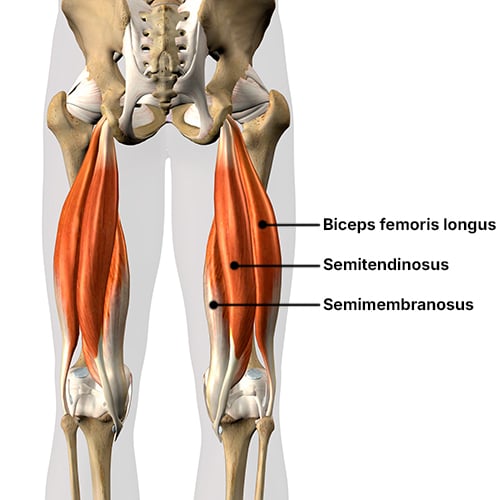
A pulled hamstring is an injury to one of the three muscles in the back of the thigh: the semitendinosus, the semimembranosus or the biceps femoris. The biceps femoris is further divided into a long head and a short head, and it is the most commonly injured muscle of the three.
All of the hamstring muscles originate on the pelvis and insert onto the tibia and, in the case of the biceps femoris, both the tibia and fibula (lower leg bones). They therefore cross both the hip joint and the knee joint, serving as extensors of the hip and flexors of the knee. Athletes can partially or completely tear the tendon at the attachments at the pelvis or at the knee, the muscle tendon junction, or the muscles themselves.
What causes a hamstring strain?
A hamstring injury is caused by overloading or overstretching of the muscle that exceeds its immediate flexibility. This type of injury can be more acute, happening recently with an obvious event, or more chronic from overuse. It is often a result of insufficient or improper warm-up before heavy sports activity. In addition, inadequate hydration before and during sports can cause hamstring cramps, which make them more prone to injury. A number of risk factors have been identified for hamstring injury including: deficits in strength and flexibility, advanced age, a reduced hamstring/quadriceps (H/Q) ratio, and asymmetry in strength and flexibility between limbs.5
What are the symptoms of a hamstring tear?
In both acute or chronic hamstring injuries, patients report pain in the back of the thigh, particularly as they initiate bringing the leg backwards during running. Those with an acute hamstring injury often complain of a sudden, sharp pain in the back of the thigh during activity. There may be swelling or tenderness within a few hours of injury with possible bruising or discoloration along the back of the leg. There may also be report of feeling a “pop” in the back of the leg.
How can I prevent a pulled hamstring?
It used to be believed that stretching the hamstrings was the best way to prevent a hamstring strain. However, many people found that they continued to suffer hamstring injuries over and over again. More recently, successful prevention strategies have included stretches along with a combination of dynamic warm-ups and targeted exercises. These include:
- Trunk and lumbopelvic control exercises (to promote motor control throughout your trunk, low back, pelvis and hip)
- Eccentric hamstring strengthening (isolated hamstring exercises targeted at strengthening the muscle as it lengthens)
- Quadriceps and iliopsoas flexibility exercises (to increase flexibility of the muscles at the front of your hip and thigh)
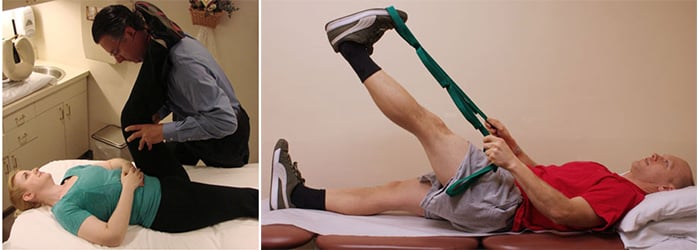
Hamstring stretches – assisted and unassisted
How do you put these into practice? A sport-specific dynamic warm-up should be performed prior to any workout or competition, and may include such movements as cariocas, side shuffles or high knees. A licensed physical therapist, certified athletic trainer or certified strength and condition specialist can help you develop a complete program tailored to your sport.
How is a pulled hamstring diagnosed?
The diagnosis is initially made based on a history and physical exam. When examining these muscles, a clinician can often see swelling and bruising: signs that the muscle has been injured. Sometimes an MRI is needed to further evaluate the extent of the injury as well as to determine its precise location. In severe cases there may be a palpable defect in the muscle (where the evaluating clinician can feel the injury).
In a diagnosis, the severity of a hamstring injury may sometimes be graded according to various scales – such as mild strain versus a complete tear or by localization of the injury (injury to the tendon, to the muscle, or at the muscle tendon junction). This can help guide treatment.
How do you treat a pulled hamstring?
The majority of pulled hamstring injuries are partial-thickness tears. In other words, only part of the muscle has been torn. These can most often be treated successfully with rest, ice, compression, elevation (also known as RICE), and nonsteroidal anti-inflammatory drugs, such as ibuprofen. This will be done for the first week, followed by progressive functional physical therapy for three to four more weeks, as needed. Return to full activity is usually allowed when the patient is pain free, has full range of motion, and full strength.
More severe injuries, such as partial tears with significant loss of strength and complete tears, lead to longer periods of rest. Injury which leads to retraction of the hamstring muscles can lead to decreased function and strength.
When is hamstring surgery necessary?
Most hamstring strain or pull injuries are partial thickness tears, in which only part of a muscle is torn. Surgery is usually not required except for extreme injuries, such as when a hamstring tendon is torn completely off the bone and won’t heal on its own. Hamstring repair may be performed as either open or endoscopic surgery, depending on each person’s particular case.
Rarely, some complete tears have been shown to scar in and entrap the sciatic nerve, leading to sciatic nerve injury that can result in weakness or numbness and tingling in the leg. This can then require surgical release. Therefore, surgical intervention may be required in cases of a complete tear with retraction of the hamstring tendon and significant loss of function. Recovery from hamstring repair surgery under a guided physical therapy regimen may take 6 to 9 months to return to full activity.
HSS research has shown that most patients still reported favorable outcomes five years after surgical repair. Several factors shown to affect individual patients’ noticeable improvement included their age, initial hip condition, body mass index (BMI), and whether they needed to be admitted rather than have an outpatient procedure.
Key takeaways
A hamstring strain is an overstretching or tear of the thigh’s hamstring muscles, most often the biceps femoris.
Symptoms include sudden sharp pain, swelling, bruising, and weakness in the back of the thigh, often occurring during running or kicking.
- Injuries are graded from 1 to 3, ranging from mild microtears (strains) to complete ruptures that significantly reduce muscle function.
- Most strains heal with nonsurgical treatment such as rest, ice, compression, elevation (RICE), NSAIDs, and progressive physical therapy.
- Surgery is reserved for severe cases, such as complete tendon tears with retraction or those causing nerve entrapment.
- Prevention emphasizes dynamic warm-ups, eccentric strengthening, and trunk/hip stability training rather than stretching alone.
References
- Fenn TW, Brusalis CM, Allahabadi S, Alvero AB, Ebersole JW, Nho SJ. Association Between Proximal Hamstring Tear Characteristics and Achievement of Clinically Significant Outcomes After Endoscopic and Open Repair at Minimum 2-Year Follow-up. Am J Sports Med. 2024 Feb;52(2):390-400. doi: 10.1177/03635465231216118. Epub 2024 Jan 5. PMID: 38179612. https://pubmed.ncbi.nlm.nih.gov/38179612/
- Fenn TW, Timmermann AP, Brusalis CM, Kaplan DJ, Ebersole JW, Nho SJ. Clinical Outcomes After Open and Endoscopic Repair of Proximal Hamstring Tendon Tears at a Minimum Follow-up of 5 Years. Orthop J Sports Med. 2023 Nov 23;11(11):23259671231209054. doi: 10.1177/23259671231209054. PMID: 38021310; PMCID: PMC10668568. https://pubmed.ncbi.nlm.nih.gov/38021310/
- Lawton CD, Sullivan SW, Hancock KJ, Burger JA, Nawabi DH, Kelly BT, Ranawat AS, Nwachukwu BU. Achievement of the minimal clinically important difference following open proximal hamstring repair. J Hip Preserv Surg. 2021 Aug 19;8(4):348-353. doi: 10.1093/jhps/hnab068. PMID: 35505799; PMCID: PMC9052411. https://pubmed.ncbi.nlm.nih.gov/35505799/
- Lin Y, Sahr M, Lan R, Nguyen J, Tan ET, Sneag DB. MRI findings correlate with difficult dissection during proximal hamstring repair and with postoperative sciatica. Skeletal Radiol. 2024 Nov;53(11):2449-2457. doi: 10.1007/s00256-024-04668-6. Epub 2024 Apr 6. PMID: 38581584. https://pubmed.ncbi.nlm.nih.gov/38581584/
- Rudisill SS, Varady NH, Kucharik MP, Eberlin CT, Martin SD. Evidence-Based Hamstring Injury Prevention and Risk Factor Management: A Systematic Review and Meta-analysis of Randomized Controlled Trials. Am J Sports Med. 2023 Jun;51(7):1927-1942. doi: 10.1177/03635465221083998. Epub 2022 Apr 6. PMID: 35384731. https://pubmed.ncbi.nlm.nih.gov/35384731/
- Macdonald B, McAleer S, Kelly S, Chakraverty R, Johnston M, Pollock N. Hamstring rehabilitation in elite track and field athletes: applying the British Athletics Muscle Injury Classification in clinical practice. Br J Sports Med. 2019 Dec;53(23):1464-1473. doi: 10.1136/bjsports-2017-098971. Epub 2019 Jul 12. PMID: 31300391. https://pubmed.ncbi.nlm.nih.gov/31300391/
- McGrath TM, Fontana MA, Toresdahl BG. Injury patterns and healthcare utilization by runners of the New York City Marathon. BMJ Open Sport Exerc Med. 2024 Mar 27;10(1):e001766. doi: 10.1136/bmjsem-2023-001766. PMID: 38562153; PMCID: PMC10982772. https://pubmed.ncbi.nlm.nih.gov/38562153/
- Pollock N, James SL, Lee JC, Chakraverty R. British athletics muscle injury classification: a new grading system. Br J Sports Med. 2014 Sep;48(18):1347-51. doi: 10.1136/bjsports-2013-093302. Epub 2014 Jul 16. PMID: 25031367. https://pubmed.ncbi.nlm.nih.gov/25031367/